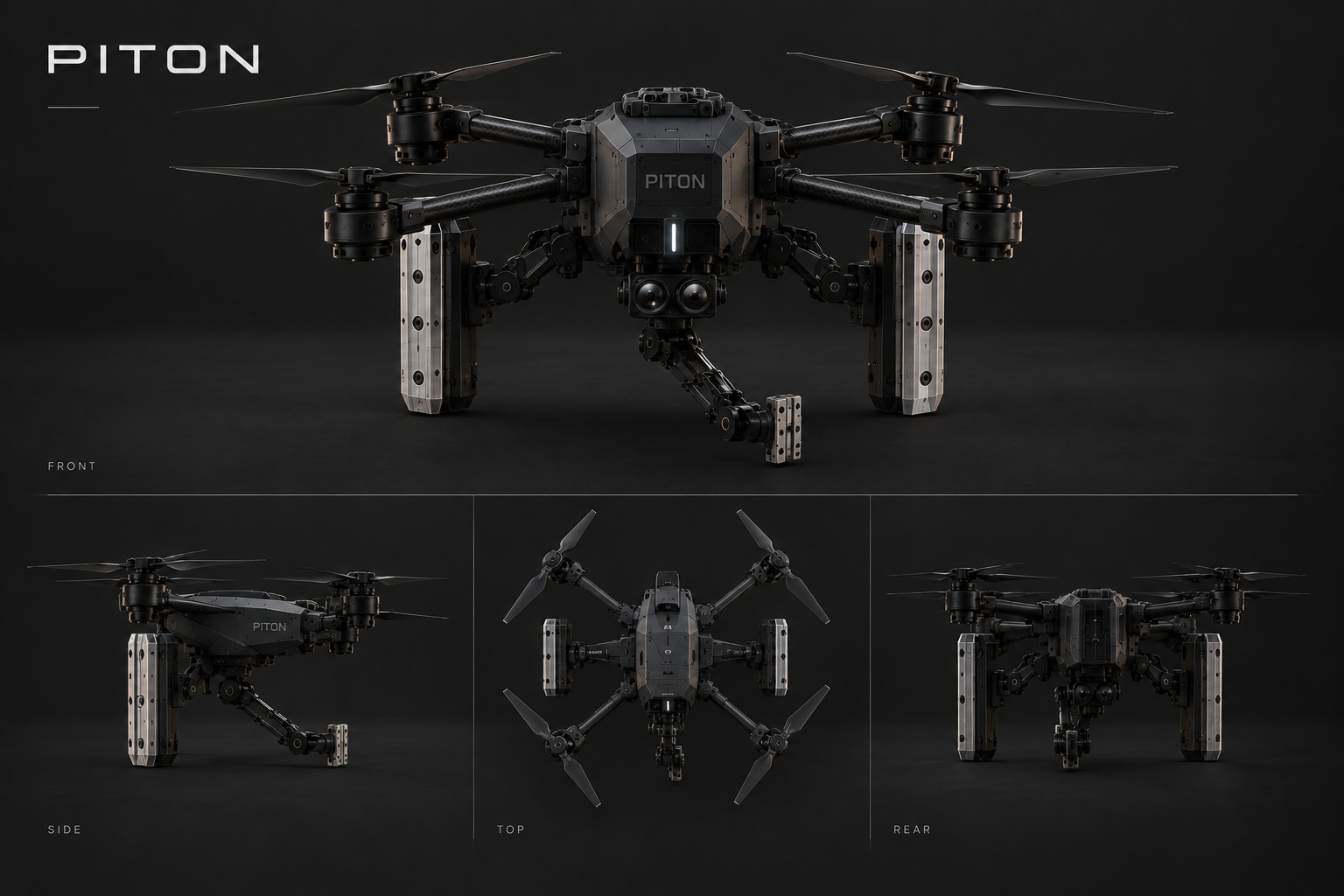
An aircraft that lands on a steel structure, shuts its rotors off, and does the hands-on inspection while it holds on.
piton, n.
That's the product in one sentence. Hovering aircraft can reach anything but can't stay in contact for long — every second on the rotors is a second off the battery. PITON lands, latches, and shuts the rotors off, so the aircraft becomes a fixture on the steel instead of a machine fighting to hold position.
Same mission, same battery, same wall — one aircraft hovering in contact, one perched on PITON's magnets and friction. Animated recreation played at 50× speed — watch the original run.
Closes the last meter into a wall on purpose and latches onto vertical steel under its own control. Rotors shut off the moment it's attached.
Electro-permanent magnets hold with no current draw. One pulse latches; another releases. No power is spent just staying attached.
With the rotors off, the payload battery sets the dwell time, not flight time. Wind stops mattering the moment the feet touch.
Fly, look, land, latch, measure, release. Repeat until the structure is covered.
Pilot or mission plan brings the aircraft to within a meter of the station.
A depth camera builds a point cloud and picks a flat, clean patch to land on.
Rotates to the wall and closes the last centimeters, feet touch under control.
One pulse sets the magnets. Motors stop. The aircraft is now a fixture on the steel.
The arm sweeps a grid: thickness, coating, continuity, tap test. Each reading is tagged to its position on the model.
Rotors spin up, a pulse releases the magnets, and the aircraft backs off to the next point.
A 3D model with every contact reading pinned to where it was taken — exportable to the report the inspector already writes.
Same stations, a real trend line — not a fresh inspection starting from zero.
FIRST
Inspected every three to five years under AWWA M42. Regional contractors already fly visual drone inspections and still send people up for the thickness readings.
SECOND
Tens of thousands of utility-scale turbines, each a steel tube with welds and a lightning conductor that has to be tested. The buyer for drone-based contact inspection already exists.
THIRD
Federal standards require hands-on inspection of fracture-critical steel members — today, that means a snooper truck and a lane closure.
Water tower, tank, or turbine — tell us the structure and we'll talk through what PITON can do on it.
Request a demo